Showing posts with label egypt. Show all posts

Tuesday, November 29, 2011

The Final Stroll in Egypt


The afternoon that we had reached Cairo after the trip to Aswan and Luxor, we went out in search of a restaurant for lunch.  Though it may sound show off to many people, we were fed up with the five star cuisines that pampered us on the previous eight days. Our Kerala palette craved for some spicy taste.  We headed to the Egyptian restaurant Felfela suggested byAli.

We walked under the mild rays of afternoon Sun. The streets were in shades and a lot of college students roamed around. As we reached the Hoda Sharawi Street, there were at least five restaurant boards with the same name. However, we were lucky enough to get into the correct restaurant after so many inquiries.

The restaurant was decorated in the theme of a garden.  Though meat was prominent in the menu, they had a wide variety of Vegetarian dishes also to serve. We ordered a vegetable casserole and a spicy mousakka. Food never tasted better in a foreign land.

After the comfortable lunch, we came back to the hotel to take rest. Since our departure is scheduled only for the next day, we decided to take a stroll across the banks of the Nile. It was the day of Eid. The footpaths were crowded and there were a lot of activities going on.  

Since being irritant to the crowds, we chose a lonely bench from where we can watch the Nile and admire the fireworks. However, the bench was already occupied by teenage lovers who were busy in exchanging intense Eid greetings.  I just wondered, this is not a European country, but a well known orthodox Muslim country! Do such public displays of affection happen here too? Well, love knows no restrictions...

Khan el-Khalili market
Chandeliers
On the day of our departure, we decided to take a final stroll in the streets of Egypt.  We were guided to the famous Khan el-Khalili market that was once known as the Turkish bazaar. The market seemed to be an ethnic market with a lot of shops selling Egyptian antiquities. We shopped for souvenirs and other tit bits. Time was running faster in Khan el-Khalili. We finished our visit at a road side open cafe. I really don’t remember what we had for lunch on that day, since I was caught up in the beauty of the magnificent chandeliers in the opposite shop!

Yes, eight days became a memory to cherish in our life forever. We felt all refreshed and together as we boarded the flight in the evening. As I heard the announcement for landing at the King Khalid international Airport, I was excited! After all, nothing is better than homecoming even if it means home in a foreign land.

The End

Saturday, November 19, 2011

The Stroll in the Streets of Egypt


Yes, Our Egypt travel is at the end. Nariman dropped us at the cruise by afternoon. After a refreshing sleep and hectic re-packing, we were soon ushered to the cozy train. Sleep lulled our eyes and the golden rays of the Cairo Sun were already upon us as we woke up.

Ali was ready to welcome us back at Cairo. We again re checked into Hotel Nile with the view of Egyptian museum. We settled down, laid back and realized with a sweet pain that our visit is over at Egypt. Even if we visit another time, so many things would have changed! Even the freshness in our eyes to the country would have faded.

As I looked out the streets, I realized that some of the best parts in the trip include a few strolls in the various streets of Egypt. This travelogue would be incomplete without any mention of them.

Aswan
On our first evening at Aswan, we took a leave from the cruise and went out to explore the city life. Horse carts were luring the tourists all around. We walked to the nearby Aswan market that sold spice, Nubian antiquities, souvenirs and jewellery.

The vendors were smart enough to spot us out us Indians! As we proceeded, many of them started to call out their familiar Indian names, “Amitabh Bachchan, Sharukh Khan, Madhuri Dixit etc.” We were fascinated for sure.

We entered a shop that sold Papyrus paintings. The price was on a higher side and we satisfied with two small pieces. As we paid the shopkeeper, the shop assistant started praising my eyes, “Mehabooba, you’ve got such beautiful eyes.” Never in my life, anyone has told my eyes were beautiful and I never felt so. I thought the old man to be crazy. However, it turned out that he had expected some tip from us and was spreading his net for that.

The night was young and pleasant in the market. We spent almost three hours in the market. We hired a horse cart to come back. As we galloped through the Aswan streets, the breeze seemed sweeter than ever.

Luxor

Karnak Temple at Night
On the eve of our departure from Luxor, we wished to take a final look at the Luxor and Karnak temple in night lights. We hired a horse cart and reached the temples. The majestic temples looked deserted and silent in the night life. The umpteen lights seemed to have failed to light up the vast areas. The scene was sad and eerie.

On the way back to our cruise, two sign boards caught our attention-Luxor Museum and Mummy Museum. We postponed the visit to the Luxor Museum for the next day. (It didn’t happen after all!). We got into the Mummy museum that charged a less price as the entry fee. The museum had mummies of many animals, leaflets on the history and procedure of mummification, latest samples on the attempts of mummification and the mummy of a priest in the Pharaoh period. 

It was a very good museum compared to the Mummy room in the Cairo museum. However if you are so keen to view the mummies of pharaohs, there is no other option but to visit the Mummy room in the Cairo museum. All these mummies looked same and ghastly to me...

Wednesday, November 2, 2011

The Valley of Workers and Colosssi of Memnon

Continues from The Woman Power in Ancient Egypt-Queen Hatshepsut


The visit to queen Hatshepsut’s temple had brought severe burns on our skin. I had had enough of the trip and looked forward to get back home. Wait; there are two more places to visit-the valley of workers and the Colossi of Memnon.

The ruins at the Valley of workers
The valley of workers was deserted as we reached the place. This was the place where the builders of the ancient representations of Egypt had once lived! This place must have been crowded with echoes, laughter, pangs and all other human emotions in those days.

The Pharaohs used to start the construction of their tombs during their lifetime itself. For this, they used to bring the artisans from faraway places and provided the workers with shelter, food and necessary needs. The works of the tomb might go for a lifetime and the workers started to have their own families in Egypt.

Soon, the first arrivals started to get old, and for their after death rituals, they started to construct miniature tombs resembling their masters. Often, the worker who leads the other workers used to get these master tombs. Some of them are still well preserved for the coming generation to witness their pride.

Entrance to the tomb
I was determined not to get out of the car as we reach the valley of workers. Enough had been seen and no more troll under the blazing sun. Some tombs stood amidst the ruins of old houses. They mimicked the shape of pyramids and looked as anthills compared to the majestic Pyramids.

We got down and waited at the lounge while Nariman went to get the tickets.  I had asked her not to get the tickets for me. But, she returned with the tickets for both of us and offered a hand in taking care of Shreya. Well, that was a relief indeed. 

We went down into the tomb that again resembled the tombs that we had visited at the Valley of Kings. The main difference was that this tomb was smaller in its area and had fewer paintings on its walls. As I came out, my imagination prompted me even to get the smell of sweat in that tomb!

We drove back to the comfort of the hotel and stopped on the way at the Colossi of Memnon. The twin statues of the Pharaoh Amenhotep III made in quartzite sandstone sat majestically in an otherwise barren land.  The hero of the Trojan war, who got ultimately killed by Achilles always invoked his subjects even after his death.

Colossi of Memnon
It seems, quite synonymous with his name Memnon, which means “Ruler of the Dawn,” the statue used to make sound in the early mornings. Many people considered it as the voice of Memnon’s ghost while others attributed scientific reasons for that. However Memnon stopped singing lately. Now, the statues are abode for many fluttering doves. As we looked on, the doves continued their routine not even caring for the umpteen visitors who gazed at their home in reverence.


Sunday, October 16, 2011

The Woman Power in Ancient Egypt-Queen Hatshepsut


 Continues from The Valley of Kings!

We were driving to the temple of Queen Hatshepsut, when Nariman told us the story of the only one powerful woman Pharaoh in Egypt. Queen Hatshepsut was the sister and first wife of King Thutmose II. After the death of the King she claimed the throne replacing her child nephew/step son Thutmose III.

Queen Hatshepsut’s twenty year’s rule was a golden era in Egyptian history. Trading and economy flourished, temples were restored or newly constructed and Egyptian culture flourished to a new realm. However the good times didn’t last longer. Her nephew, Thutmose III, also known as "the Napoleon of ancient Egypt,” had married Queen Hatshepsut’s daughter and rose into power.

Thutmose III started wiping off the signs of Queen Hatshepsut from Egypt.  He cut her names away from the temple walls and destroyed the monuments constructed by her. However, Queen Hatshepsut’s charisma prevailed over these wile activities. 

We reached Queen Hatshepsut’s temple at Deir el Bahri by noon. The burning sun competed with my idea to visit the temple. I finally got down from the car.

In front of
Queen Hatshepsut’s temple
Queen Hatshepsut’s temple was indeed a token for the female Pharaoh’s power. Standing in the higher realms of desert plain in a series of terraces, the temple beheld its majesty. A root of the tree once brought by Queen Hatshepsut from Punt during an expedition was covered and exhibited at the temple entrance.

The temple looked synonymous with the heat reflecting limestone cliffs around it. Nature must have lent its hand in the construction of this temple. 

Woman Power: In front of
Queen Hatshepsut’s statue
The monuments of the female Pharaoh arrayed the temple corridors. However, in comparison with the other temples that we had visited, the temple was smaller in its area.  The walls depicted many expeditions of Queen Hatshepsut, whose names and face have been erased at many places.

After some minutes of visit, we came out. The temple overlooked green fields and hills at the opposite side. They seemed to be a mirage at that point and a token of the contradicting culture that we might never comprehend!

Saturday, October 1, 2011

The Valley of Kings!


We’d been picked up in the early morning to visit the valley of Kings. It was our first travel across the Nile since we started our sail. We passed many half constructed houses on the way. Nariman explained that most of the natives leave their houses half constructed for their next generation to build a home of their own.

The scenery started to change from the lush green foliage at the Nile banks to the barren mountains. On both sides of the road, Theban hills glistened under the hot sun. We anticipated a hot day as the previous day but, never a worse one!

We reached gates to the Valley of Kings within half an hour of our drive. Beyond the gates laid, vast stretches of land that had once been the burial ground for royalties in Egyptian New Kingdom. As of then, there were 63 tombs, out of which three were open to visitors.

Theban Hills
Cameras and personal vehicles were not allowed beyond the gates. As we finished the procedures and waited for the tram to transport us to the tombs, I looked around. Here lay the tombs of the historical figures in Egyptian culture. Many archaeologists and Egyptologists made this area as their haven... Many of the tombs had been opened and robbed off treasures; the major being the tomb of King Tutankhamen!

The tram came to take us to the tombs. We passed the twisting roads under the Theban hills and reached a crowded place.  Nariman explained that owing to the arrival of Nile cruises, the number of visitors on that place would cover more than nine thousand per day. However, being an off season, visitors are less on the day compared to the other days.

We were to visit three tombs in the valley of Kings.  At first we visited the tomb of King Horemheb numbered as KV57 (Valley of Kings Number 57). No guide would come in to assist us and we had to maintain silence inside the tombs. King Horemheb was the last King of the 18th dynasty. Paintings depicting scenes from Egyptian mythology gave some clues to the beliefs and funerary rituals of the period. 

Entrance to the Valley of Kings
The next tomb that we gained entry into was that of Ramesses VI numbered as KV9.  We had to enter the narrow path resembling the entrance to the tombs inside the Pyramids. The decorative images were in a well preserved state than those of King Horemheb’s tomb. Ramesses VI enlarged the tomb of Ramesses V to make it his own. The tomb though thoroughly robbed and excavated gave an idea of the opulence and power of the rulers of the time.

Finally, we reached the tomb of King Tutankhamen. The entry fee is much more than the fee into other tombs. We were definitely interested in this tomb than others since we had a glimpse of the treasures that this tomb had once consisted.  The mask of Tutankhamen, his gold bed, gold chambers etc. at the Cairo museum had boasted the majesty of its owner.

The tomb had an entrance corridor, staircase, antechamber and burial chamber. The paintings were not stretched to all walls. Even after being robbed of its treasure twice, the tomb still holds the affluence of the boy King.

The tombs where the excavation continues...
When we came out of the tombs, Nariman explained to us about the curse of Pharaohs.  It seems many people who had aided in opening the tomb of King Tutankhamen, died of mysterious accidents. Howard Carte, who was the principal leader of the excavation of King Tutankhamen’s tomb, suffered many mysterious hardships. A cobra that resembled the cobra at King Tutankhamen’s crown had once hunted his pet parrot. Jackals of the same type as Anubis that guarded King Tutankhamen’s tomb came in front of him for the first time in over thirty-five years of explorations in the valley. Yet the explorations continue...


We came out of the valley thoroughly exhausted. As we had started to drive back, I just thought! How would the majestic royalties would feel if they were aware that their personal burial grounds and their well kept wives’ burial grounds being peeked on everyday by countless foreigners over the years?


Tuesday, September 13, 2011

Luxor Temple: The Dazzling Preservation of a Culture


We reached Luxor temple in the mid afternoon. It is a sacred place of wonderful architecture built since 1550 B.C. The afternoon heat scorched on our thickly tanned bodies. Yet, we wanted to visit the last temple in our itinerary.

Entrance to Luxor Temple
The massive entrance pylon built by Rameses II welcomed us. Two colossal seated statues of Ramesse edged the entrance in all grace. There was one obelisk on the left side of the entrance with names of Ramesses II, Horace, Amun and the King’s favourite Gods on each vertical side. However, the space for Obelisk on the right side was vacant. Nariman explained that the obelisk had been carried to France and now can be seen at Place de la Concorde, in Paris.

Headless Statues of Luxor temple
We entered the Luxor temple. Just inside the temple was a mosque built over the ruins. Compared to the other Egyptian temples that we had already visited, Luxor was in a less preserved state. Arrays of headless statues stood around the courtyard. 
Roman Mural

It seems invaders considered Luxor temple as a catch for them. The Roman invaders made the temple and its surroundings as a fortress for the Roman government. There was one Roman mural on the temple wall depicting the Christian devotees.

Nariman ushered us to the court of Amenhotop II. A better preserved area in the temple, it was flanked by double rows of Papyrus columns with bud capitals. The reliefs on both sides of the hall depicted Amenhotop II's coronation by the Gods.

Nariman left us there to admire the beautiful architecture by ourselves. We roamed around the yard of the Theban triad-Amun, Mut and Chons. This is the same place where ancient Egyptians gathered to praise their protectors and celebrated the famous Opet festival. This is where, the Christians had raised their church and Muslims later conducted their prayers. 

Sphinx Avenue
Yet, there was not much for our eyes in the temple and we came out. We were soon led to the Sphinx Avenue that once led all the way to the Karnak temple. The sphinxes still remained in better condition.

It was time for us to retreat to our cruise. We relished the welcome drink and the wet towels offered as we’d entered the boat. There was a relaxing afternoon ahead us to get prepared for next day’s travel.

Continues in The Valley of Kings!

Sunday, September 11, 2011

Karnak Temple: The Most Perfect of Places

Continues from The Nile: Unsurpassed Expressions of Waves 
 
When we woke up in the morning, the cruise had come to the final halt. On the day, we would visit two of the most famous temples in Egypt-Luxor and Karnak temple.

Our travel guide Nariman was waiting for us at the front desk. After ten minutes drive, we reached Karnak, a sacred place of built since the 30th dynasty in Egypt.

Nariman first guided us to the miniature presentation of Karnak temple at the main entrance. A glimpse at the miniature presentation revealed that we had no chance to view the entire temple. Nariman explained that we would be visiting a part of the Eastern section of the temple.

The sun seethed on the visitors at the temple yard. It was really a challenge to step onto the yard under the blazing sun. Yet, we ventured it and the result was worth it.

Entrance to Karnak Temple
Ramesses II
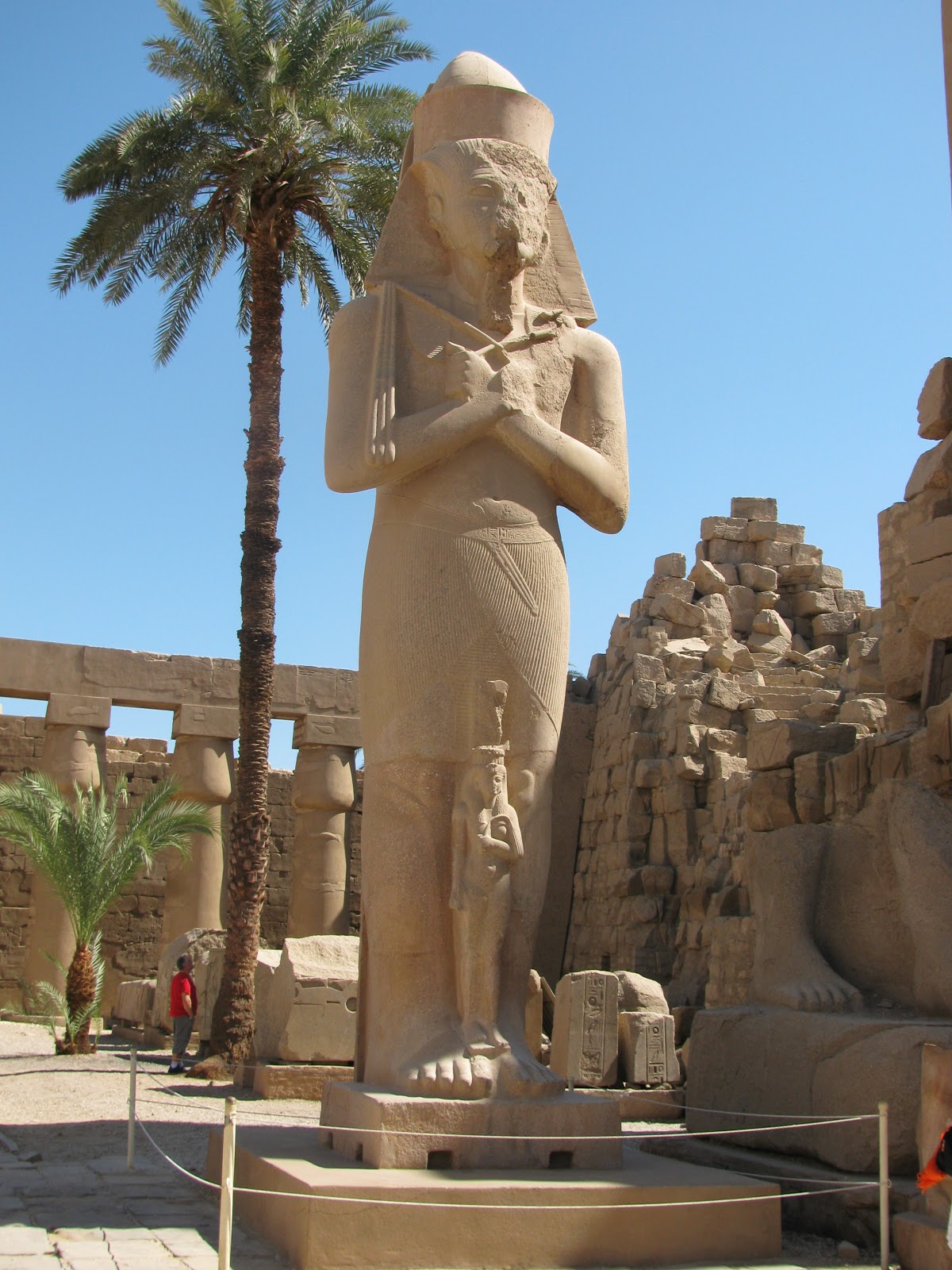
Human headed Sphinx Avenue welcomed us before the huge colossal gates.  Each sphinx cradled a Pharaoh under them. The Sphinx heads were created in the image of God Amun Ra, who had presided in the temple. At the entrance were the two huge statues of Ramesses II with his hands crossed on his chest. Nariman explained that the action signified the dead status of the King.

Close image of the Sphinx
We entered the temple with its ruined mud yards and an array of sphinxes on its side. Many visitors were trying different poses in front of it. There was a woman jumping with joy in front of the sphinxes while her husband tried to capture the moment behind the lens.

We passed many headless statues on the corridor before reaching the many pillared hall. Nariman explained the invaders were adamant in removing the Pagan tradition and beheaded many of the statues. Many of the statues were faceless, nose less and ear less owing to the invasions. 

The many pillared hall of the temple displayed pillars designed with Papyrus and lotus like the pillars of Philae, Edfu and Kom Ombo. The pillars in the precinct of Amun were free standing and had inscriptions all around them. 

The Rising Sun Obelisk
There was a beautiful obelisk belonged to Queen Hatshepsut behind the pillars on whose tip the Sun always seemed to raise on the day time. There had another one belonged to the Queen but toppled by her nephew Thutmosis III.

The Scarab Beetle
Nariman left us at the temple pond to have a look by ourselves. There was a pylon with a huge structure of Scarab-beetle on it. For many years Egyptians worshiped the scarab beetle for its association with the creator God Amun. They had believed that the beetle pushed the Sun around the planet to ensure fertility for the country. 

We came out in exhilarated and exhausted at the same time. We have to head to Luxor temple soon. The Sun’s rays blinded us, yet we wanted to!


Continues in Luxor Temple: The Dazzling Preservation of a Culture

Sunday, September 4, 2011

The Nile: Unsurpassed Expressions of Waves

Continues from Into the Domain of Hawk-Edfu Temple

We reached the cruise earlier than the Spanish tourists returned! There was ample time to take rest before the evening tea. As we were getting into the room, the guy from the spa came out and greeted us. Definitely, I got interested in the guy, who acutely resembled Harry Potter with his  round glasses, girlish grin and disheveled hair. After a conversation with him, both of us decided to get a spa treatment with the arrangement of each of taking turn to take care of Shreya. 

It was evening by the time we finished our spa treatments. The cruise had already started its sail by the time we went to the upper deck for tea. The sun had started his descend for the day, turning the waves of Nile into dark black.

The mist stretched across the water. We took our cups of tea and went to the forefront seats on the terrace. We immediately regretted! The tea instantly turned cold and the chilling wind started to sweep on our face. Little Shreya grinned in merry with the chill weather.

A Cruise in the Nile
It was then that we noticed the other cruise sailing behind us. Our cruise manager explained that they always travel in a convoy mode in watch for some emergencies.

Nile after the Sunset
Life flew on both sides of the Nile. A group of water birds headed in hurry towards their destination. The sun would sink at any moment and night cover the activities on the water. As if in a hurry to complete the day duties, the waves in the Nile fluttered frantically. At last the sun sank! The waves became calm as if something had dropped into it and submerged into the bottom.
No more had seen of the Nile. We listened to splashing music of Nile for some time and went down to our room. As we lay in our room, listening to the growling engine and splashing waters, I thought of the difference between day Nile and the night Nile.
Nile was in its best charm as we’d sailed from Aswan to Edfu. T he deep blue water evoked lush green waves on its banks. Just beyond the green growth, burning soil of Sahara desert glistened and craved for the touch of Nile.
Many camels had grazed on the river banks while farmers walked busy with their routines. We never knew time skipped into hours as we sat near the huge glass pane windows in our room, watching the beautiful expressions of the Nile.
For the lunch we had descended to the restaurant which came beneath the water level. The waves splashed across the window pane next to our seats. The waves seemed to touch us but danced back in glittering sunshine. It was an exotic experience for sure! We savored the view for a long time after finishing our lunch.
The dinner time took me away from the thoughts of the Nile. We went to the restaurant and took our regular seats. Our Spanish companions were busy reading the travelogue of Egypt. They suddenly rose in the midst of their dinner and hurried out of the hall. “They must have gone to see the Esna Lock,” The cruise captain who had dined with us, explained.
We had never heard of Esna Lock. It turned out to be the lock to raise and lower stretches of water between different levels of the Nile. The cruise would wait behind the closed gates in a chamber until the water level become equal. We rushed after our neighbors to watch this unheard practice.
Chill wind brazed us as we waited on the deck for the gates to be opened. Engines growled as they leveled the water in the Nile. After 15 minutes’ wait at the gate the water leveled to allow us to enter into the next phase of Nile. I didn’t felt anything great though! It may be due to my lack of interest in technical complicacies. Sreejith raved about this technique, while we came down.
The night had turned really dark as we came back from the Galapia Show at the visiting hall. I gazed through the window in hope to watch stars strewn across the Egyptian sky. The sky was dark and devoid of glitter. I dropped into sleep when the dark waters float out. The waves that cradled five thousand years of history and culture proudly floated along.


Continues in Karnak Temple: The Most Perfect of Places

Friday, August 26, 2011

Into the Domain of Hawk-Edfu Temple

Continues from Kom Ombo Temple- A Visit to the Crocodiles and the Hawks

It was afternoon by the time we took the halt at Edfu. Fatima had come with us from Aswan in assisting our visit to the Edfu Temple. The sun was blazing hot as we’d started from the cruise in an old horse cart to Edfu.

Entrance to Edfu temple
As we reached the temple, the stone floors were burning hot. My head was sleepy after a heavy lunch and needed much persuasion to move from the shades into the burning courtyard. We crossed the courtyard and entered into the temple. 

At the ruins of Edfu Temple
At the other side of the temple entrance were some mud hills in their ruined state. Fatima explained that the Ptolemaic period temple was often threatened by the annual floods in the Nile. When the time of worshippers declined, Nile took its advantage and deposited the river silt on the temple. Later, the native people started to have their own homes, right from the temple courtyard. However, the temple was recovered in 1798 without much damage.

In front of the Hawk Guard
Two mighty falcon giants, bigger than human size and made in granite, guarded the temple entrance. Many pillars with lotus and Papyrus designs adorned the entrance hall of Edfu temple also. The ancient paintings depicting the age old conflict between Horace and Seth were strewn over the walls. Though the ancient colours retained their charm, the faces of the characters were scraped out by the invaders.

There was great significance for the Nile in relation with the temple of Edfu. In the temple days, huge boats sailed across the Nile carrying the supplies for the temple. There are remains of huge barns in the temple, where Egyptians had once stored their grains. The existing huge boat in the shrine was once used by the ancient priests to accompany Horace in his divine trips.

The boat at the shrine
It seems the entry for normal people into the temple were limited only till the entrance gates. It was mandatory for the priest to take a bath before entering the temple. The entry to the shrine was limited solely to the priests and even the King had to stop in front of the shrine. Well, this was not a new custom for me who has grown up in place that still follows these rules.

Edfu temple corridors
After spending some time in front of the shrine, we climbed to the first floor of the temple. Many doves have taken place of the falcons on these days. We climbed down the mighty corridors that surround the temple. In the ancient days of war, the temple also served as a hideout for the native warriors. The corridors were a strong protection cover for them on those days.

The heat was fading a bit as we came out of the temple. We passed many stalls selling native attires. Fatima suggested us to get some dresses on discount, if at all we are taking part in the Galapia Performance in the cruise. We didn’t!

Fatima bid us good bye at the cruise. We are sailing to Luxor on the same night and a new guide will assist us there. It is always a bit sad to part forever!

Continues inThe Nile: Unsurpassed Expressions of Waves

Wednesday, August 24, 2011

Kom Ombo Temple- A Visit to the Crocodiles and the Hawks

Continues from The Evening Rays of Egypt

We were in the hangover of a deep sleep in the next morning.  The scheduled Nubian show on the previous night was cancelled and replaced by Dharwish dance and Belly dance. We came back late from the performance and collapsed into the bed. The Spanish tourists were in the midst of their breakfast as we reached the dining hall. We had to really hurry with the Egyptian breakfast not to be delayed in our schedule to visit the Kom Ombo temple.

Fatima was ready at the desk by the time we reached the reception. We took a short walk from the cruise to the Kom Ombo temple than taking the taxi. The temple dedicated to the crocodile god Sobek and the hawk god Horace, stood at the bend of the Nile. While we walked to the temple Fatima gave the information that, the pavement where we walked, had once been the place for crocodiles to bask in the sun!

The tall entrance to the temple itself claimed that the structure hold not only one powerful existence but more than that. We first entered into the court of Sobek, dense with huge pillars. An uneven number of fifteen pillars were arranged in a triple row there. Some of them were destroyed but still behold the image of Sobek on them. 
A pillar with the image of Sobek

The Image of Childbirth
It seems that the ancient Egyptians considered the sanctuary of Sobek as an ideal place for childbirths and surgeries. Many images on the wall, depicting these scenes asserted this concept. 

Fatima ushered us to a well near the temple where once Sobek had ruled. The myth is that the guardians of many infertile women had used to send those women to this domain of Sobek. Without any doubt, the women would be fertile by the next morning! I really felt dizzy looking into the well which, was littered with cigarette butts and beer bottles.

Wall Paintings
Ancient Egyptian Calendar
The northern part of the temple was dedicated to the falcon god Horace the elder. There were beautiful paintings of Horace in ancient colours at the roof of the temple. On the walls of the temple ancient calendars written in hieroglyphics still remained accurate. Ancient Egyptians calculated the festivals depending on these calendars. The backside of the temple was almost annihilated owing to annual floods in the Nile, earthquakes and invaders. However, there still remained ancient wall reliefs escaped from the traitors against preservation.
Wind blew heavily across our face as we entered back into the pillar hall.  It was time for us to return to the cruise and start our sail to Edfu.
A panoramic view of the Kom Ombo temple

As the cruise engine started to hum and wade through the waves in Nile, I looked across the window. Kom Ombo temple was getting distanced from our view. Somehow, I felt the view familiar! Isn’t it a similar view that I had at an ancient temple at the banks of a Kerala river?
Surprise for Shreya


Afterword: There was a surprise waiting for Shreya as we returned to the room on the previous night- a puppy made out of a towel. However it had changed into a bird and sitting at the head of Shreya’s cradle while we returned from Kom Ombo trip. What more? It was wearing the little one’s abandoned dress and cap.

Continues in Into the Domain of Hawk-Edfu Temple

Tuesday, August 23, 2011

The Evening Rays of Egypt!

Continues from Philae Temple-The Creation of God’s Home! 

The evening sun was turning golden in the horizon as we reached the banks of the Nile. The schedule was set for a felucca sail around the Elephantine Island. We started our sail from the straits of oldest hotel in Aswan where eminent personalities like Winston Churchill and Agatha Christie had reserved their rooms. As we started sailing, I looked back at the retracting scene of the hotel. How many characters must have born from Agatha’s pen while she peered into these waters from those windows!

The first scene we came across was the ruins of Yebu and the ancient nilometer. The nilometer was a structure constructed during Pharaonic times to measure the annual flood. Depending on this measurement, ancient Egyptians decided on the agricultural cycle of the year. Truly an admirable creation, their ruins clearly remain a proof for the ancient Egyptians' wisdom.

Our guide Fatima, who was from the elephantine island, was very passionate as she pointed out to the scenes of her home island. She was especially fond of the botanical garden of Lord Kitchner, a former counsel general in Egypt. It seems Lord Kitchner cradled a passion for flowers too. It seems the thickly green area is home for rare species of flora from all over the world.

Burial grounds of Agha Khan Mausoleum
We also sailed near the burial grounds of Agha Khan Mausoleum, the former leader of Ismaili Muslims. It was quite a scene to watch the beginning of Sahara desert on the very banks of the rich river of Nile. The ruins of Agha Khan Mansions boasted the luxuries of the land by their reflections on the evening waters. 

Feluccas
Grand old feluccas sailed in the direction of wind across the river. I expressed my desire to sail in them but immediately took it back. At a turn in the river a group of tourists where stuck in such a felucca in anticipation for the wind. 

As we reached back in our cruise, I asked the question, “Why this island is called Elephantine Island?” Fatima smiled, “There’s nothing to do with elephants in there. The island is believed to be in the shape of an elephant’s head.” With this, we parted with an agreement to meet next day morning.

Move n Pick hotel
Our evening tea was ready at the upper patio of the boat. The area was deserted as we reached there. The evening was turning misty under the crimson sun rays. On the opposite shore the only hotel in the Elephantine Island-Move n Pick- started to show off its row of lights. Though played around for some time, even little Shreya pondered over the beauty and kept silent. Much is awaiting us on the next day.


Continues in Kom Ombo Temple- A Visit to the Crocodiles and the Hawks

Sunday, August 21, 2011

Philae Temple-The Creation of God’s Home!

 Continues from Temple of Philae-A Temple for Love! 

The sail in Felucca to the Philae temple under the hot afternoon sun was delightful and tiring at the same time. The beautiful island that houses the majestic Philae temple was not the original home for Isis worshippers. The temple was earlier at an island near which, Aswan High Dam is located now!

During the construction of Aswan High dam, a looming flood threatened the existence of Philae temple. The Egyptian authorities were not ready to risk the loss of one of their regal ancestries. They dismantled the temple into 9,600, pieces numbering each piece in accordance to their existence. After a devoted effort, the temple was resurrected in the present island.

As we sailed nearer, steep sides and lofty walls, carved in Syneite stones became more visible. It seems neither a bird flies above this island nor a fish approaches its shore.  We descended from the felucca and passed a group of Spaniards resembled to come out of the movie Bucket List.

Trojan's Kiosk at the Philae Temple
The first thing Fatima pointed to us was the Trojan’s Kiosk at the entrance. However we didn’t particularly felt anything owing to its obliterated condition. Architectural wealth from various eras, extending from Pharaohs to the Caesars, was scattered in the very yard of the temple. There were remains of the faded imageries of Hathor’s story encrypted during the origin of the temple in 380-362 BCE by the orders of King Nectanebo. However what attracted us the most was the row of pillars on the side of the temple.

Pillars at the Philae Temple
Shade and light played a singular effect on the floors of the temple yard. Owing to the pillars’ position near the tropic of Cancer during the time, the view was quite unique. The ancient pillars proudly displayed two designs on their heads- the designs of Papyrus and lotus! The pillars and its walls were painted in vivid natural colours during its origin. Though the colours have lost their brilliance to time and dryness, they still retained their beauty. Various combinations of palm branches and dhoum leaf on the pillars silently promoted the artistic talent of its creators.

After admiring the beauty of the structures, we entered into the temple. The temple entrance was carved with rich images from the story of Isis. The monumental gateway to the temple was called Propyla. They were pyramidal in form and colossal in dimensions. Two colossal lions in granite stood in front of the Propyla. In my Hindu mind, they acutely resembled the ‘Dwarapalakas’ of Indian temples.

Some paintings on the walls were scraped out by Christian invaders of early eras. At each corner of the shrine stood a monolithic worship hole, the cage for the sacred hawk. The inscriptions from the Macedonian era still shone bright surviving the invasions. 

Near the image of Isis
We entered the shrine with shining walls of rich symbolic imagery. The image of Isis with protective wings around her husband was the most beautiful among them. The picture didn’t come out well in our camera lens, but got encrypted in my memory. 

The Holy cross at the entrance of Philae Temple
Native men dressed in Galapia dress were posing for the foreign cameras as we came out of the shrine. Our guide pointed out an inscription amidst the Egyptian images. A divine cross! Anyway, it wasn’t natural but had inscribed by the Roman invaders. 

The evening breeze had started to blow as we roamed around the shrine. We sat at the edge of the temple in the backdrop of the Nile. In the distance, Nubian islands sidelined the blue waters. Blissful was the feeling to be in that soil for some memorable hours!

Continues in The Evening Rays of Egypt!

Saturday, August 20, 2011

Temple of Philae-A Temple for Love!

Continues from Into The lap of Nile

Philae Temple
The afternoon sun shone bright and cloudless as we reached the shores of Nile.  The clear blue sky matched its radiance to the waters. The Felucca started its sail, taking us for the first sail in the Nile.

In the distance, we spotted some islands crowded with rocks. Fatima explained that they are dwelling place of Nubians, the tribal in Egypt. They rarely come out at this time of the day. 

As we were marvelling the unpolluted water of Nile, the water birds hopping on its surface and the Nubian village lining the shores, Fatima started to tell the story of Philae.

Once upon a time, the sky God Geb and the earth goddess Nut had four children: Osiris, Isis, Set and Nephys. Being the eldest and greatest among them, Osiris became the King of Egypt. He married his sister Isis and ruled the kingdom in excellent condition.

The good times didn’t last long. Set, who was jealous of his brother’s glory decided to attack his brother. Set transformed himself into a monster and killed Osiris. In order to prevent the resurrection of Osiris, Set cut Osiris body into different parts and distributed it among many areas in Egypt.

The Entrance to Philae temple with symbolic images of its story
Isis cried continuously over the loss of her husband. However, with the help of Nephys, wife of Set, Isis found out the body parts of Osiris. She assembled the body and with her great magical power blew life into her husband. 

Osiris went to the underworld and started his domain there. The couple had a son named Horace. As Horace grew up, he challenged Set for his rightful throne. After a series of matches, Horace emerged as the winner with the help of his mother Isis and father Osiris.

The temple of Philae is dedicated to Isis, the mother of Gods, Osiris, their son Horace and the family. It seems, the Osiris' body parts laid in the Nubian island across the Nile. The people sometimes tell that the flood in Nile happens when Isis cries for her husband. 

For centuries, the temple remained as the home for worshipers of Isis. The temple now remains as a major tourist spot beholding its majesty.

Continues in Philae Temple-The Creation of God’s Home!

Monday, July 4, 2011

Into the Lap of Nile


We must have slightly opened the window curtains on the previous night since the morning sun’s rays crept into our little cabinet to wake us in the morning. After being fresh, we opened our window curtains and started enjoying our Egyptian breakfast.

The countryside looked so much similar to our own Kerala, contributing date palms for coconut groves, corn fields for paddy fields, camels for cows and much more. Occasionally we got the glimpses of Nile shining silver in the sooth rays of morning sun. Workers were already in the field, beautifully arranging the red and ripened dates.

Our breakfast tasted so delicious with these splendid views. How much I longed for the morning to halt for long only for this mesmerisation. However, soon the announcement came for reaching the Aswan station. We waited along with a couple in our next door room at the sun lit red corridor.

The couple in our next door room was from Spain and on a six months’ honeymoon to various places. We got down at Aswan and soon said Good bye to each other. Our travel guide took us to the schedule Nile Express Cruise, one of the luxury cruises on sail in the Nile.

Into the lap of Nile!
As we entered the cruise, all of a sudden I had a feeling of concord. Here we are in the lap of crystal clear Nile in a luxurious cruise. It was like living a dream that I had long yearn for!

After the check in formalities, welcome drink and fresh hot towels we were soon shown into our well set room. Our room overlooked the Aswan outside and we soon drew our curtains from the outside world. 

We were about to unpack, when we got the call from the reception. Our visit to the High dam and temple of Philae, which had been scheduled for the next day, should be completed the day itself. The cruise is sailing on the same night and not according to the previous plans. They gave us half an hour to complete our lunch and bath. We hurried to the maximum yet reached half an hour late.

The half an hour delay caused us to forget our plan to visit to high dam. Fatima from the Nubian village was ready to assist us as our guide. On the way, she took us above the high dam and the lower dam just to have glimpses of both. The view was fantastic. 

Across the High Dam
Sitting in the car that drive across the world’s longest river, Fatima told us the story of high dam. It took 10 years to complete the construction of this dam, which determines the life of Egypt. We never knew until then that the river Nile is constituted of two rivers-the White Nile from Sobat River Bahr al-Jabal and Blue Nile from Ethiopian Highlands. 

The first dam of Egypt was constructed in 1889 and raised in 1933. However the man made dam was not able to behold the magnificent Nile in 1946. The work of the high dam was thus started by the mutual help of Soviet Union, in late 1950s. After the relocation of approximately 1 Lakh natives from their homes, reconstruction of historic places and overcoming many other hurdles, the dam got finished in 1970.

Though many resources of Nile diminished with the construction of the dam, it had played a major role in curtailing the annual floods and subsequent damage. The dam also serves as a major source of Egypt’s power supply. The high dam also ensured a smooth sail in the river by keeping a constant water flow!

As we drove above the dam, the view was majestic. The Felucass fluttered on the blue waters on the distance as white dove across the blue sky. Wonderful are the hands of men who captivated the enchanting nature on hold!

Continues inTemple of Philae-A Temple for Love!