Monday, July 4, 2011

Into the Lap of Nile


We must have slightly opened the window curtains on the previous night since the morning sun’s rays crept into our little cabinet to wake us in the morning. After being fresh, we opened our window curtains and started enjoying our Egyptian breakfast.

The countryside looked so much similar to our own Kerala, contributing date palms for coconut groves, corn fields for paddy fields, camels for cows and much more. Occasionally we got the glimpses of Nile shining silver in the sooth rays of morning sun. Workers were already in the field, beautifully arranging the red and ripened dates.

Our breakfast tasted so delicious with these splendid views. How much I longed for the morning to halt for long only for this mesmerisation. However, soon the announcement came for reaching the Aswan station. We waited along with a couple in our next door room at the sun lit red corridor.

The couple in our next door room was from Spain and on a six months’ honeymoon to various places. We got down at Aswan and soon said Good bye to each other. Our travel guide took us to the schedule Nile Express Cruise, one of the luxury cruises on sail in the Nile.

Into the lap of Nile!
As we entered the cruise, all of a sudden I had a feeling of concord. Here we are in the lap of crystal clear Nile in a luxurious cruise. It was like living a dream that I had long yearn for!

After the check in formalities, welcome drink and fresh hot towels we were soon shown into our well set room. Our room overlooked the Aswan outside and we soon drew our curtains from the outside world. 

We were about to unpack, when we got the call from the reception. Our visit to the High dam and temple of Philae, which had been scheduled for the next day, should be completed the day itself. The cruise is sailing on the same night and not according to the previous plans. They gave us half an hour to complete our lunch and bath. We hurried to the maximum yet reached half an hour late.

The half an hour delay caused us to forget our plan to visit to high dam. Fatima from the Nubian village was ready to assist us as our guide. On the way, she took us above the high dam and the lower dam just to have glimpses of both. The view was fantastic. 

Across the High Dam
Sitting in the car that drive across the world’s longest river, Fatima told us the story of high dam. It took 10 years to complete the construction of this dam, which determines the life of Egypt. We never knew until then that the river Nile is constituted of two rivers-the White Nile from Sobat River Bahr al-Jabal and Blue Nile from Ethiopian Highlands. 

The first dam of Egypt was constructed in 1889 and raised in 1933. However the man made dam was not able to behold the magnificent Nile in 1946. The work of the high dam was thus started by the mutual help of Soviet Union, in late 1950s. After the relocation of approximately 1 Lakh natives from their homes, reconstruction of historic places and overcoming many other hurdles, the dam got finished in 1970.

Though many resources of Nile diminished with the construction of the dam, it had played a major role in curtailing the annual floods and subsequent damage. The dam also serves as a major source of Egypt’s power supply. The high dam also ensured a smooth sail in the river by keeping a constant water flow!

As we drove above the dam, the view was majestic. The Felucass fluttered on the blue waters on the distance as white dove across the blue sky. Wonderful are the hands of men who captivated the enchanting nature on hold!

Continues inTemple of Philae-A Temple for Love!

Friday, July 1, 2011

Papers, Perfumes, Pavement and Passenger

Continues from The House of wonders, Culture and Generations-Egyptian Museum

Well, we’ve reached the end of the first day in our Egypt tour. Now only three things have left behind-Papyrus, perfumes and the passenger train to Aswan.

At first, our guide took us to Papyrus shop, where they methodically show the papyrus formation.  I remember repeating the method of Papyrus making for my history exams in school days. Here, in this shop, I decide to enjoy the show, leaving behind its intricacies. (For those who wish to know more about Papyrus making, here is a useful link ).

The Papyrus stems looked similar to a wild bush grown in the coasts of Kerala. The Papyrus plants were artistically potted in many places of the shop. Beautiful paintings designed in fine Papyrus sheets adorned the walls. There were many paintings in different hues and shapes. Most of the paintings were taken their inspiration from ancient mythologies. (I learnt later that you can see only the side face of the portraits in Egyptian paintings.)

The Egyptian jewellery section in the first floor was famous for delivering pendants with own names in hieroglyphics. However we had a constraint for the money and got a silver pendant with Shreya’s name in it.

My head was bustling as we headed to the perfume shop. All I wanted to do was to sleep than continuing the trip.  Yes, at times we have no choice but to continue the rhythm. 

As expected the perfume shop was filled with fragrances but, thankfully not to the painful state. We were seated on cushions with a perfume consultant to attend us. I never knew that perfumes are there for other purposes than body care. For example, fume a drop of lotus fragrance in water for peace; a drop of rose extract for harmony; apply the rose extract for confident beauty; vanilla can serve as a welcome; papyrus and some other extract for physical pleasure etc. It was like sitting in Tilo’s1 shop in California.

Even 100 ml of these specially brewed perfumes were highly expensive. We bought the smallest bottle of lotus extract and still fume the drops at home on special occasions. Trust me; the fragrance is as rejuvenating as said.

Though we bought the smallest bottle, our consultant was very friendly and jovial. After having the hibiscus tea offered by him, we came out. There was still 2 hours prior to our departure to Aswan. It was time for our guide to leave and he showed us into the Four Seasons mall where we can take refreshments. As we bid good bye to him we really felt like parting with a friend.

Enjoying the Evening Nile
The refreshments at the Four Seasons really did me good. It was then; we wanted to explore the evening life at the Cairo pavement. We stood at the banks of Nile and sat on the benches, just to see the foreign lifestyle flowing in front of us. We felt so relaxed and in high spirits of the day that passed.

Soon our driver came along with Ameer to take us to the Cairo Railway Station. Curiously the station looked similar to the ones we see at Bangalore. Sreejith smiled at my comparison and said, “Let’s see.” 

Metro trains in high speed passed us as Ameer told about his family, the party they are having at home etc. Our train came on time and Ameer left us with a wish that he would meet us again after 5 days. 

We entered the train and I was just felt myself in a movie. The door opened to a corridor with red carpet. We were ushered into a private room with a small cupboard, fixed bunk beds, wash basin and a lavatory. Wow, I have never traveled in this much luxury before.

However, I never had much time to marvel these. My feet was tired so as Sreejith’s! After a quick Egyptian dinner, we were ready to drop down. Shreya wanted to play but, we first put her to bed. I don’t even remember touching my pillow that I drifted into a dreamless sleep.

1.    1.   Tilo is the protagonist in Chitra Divakaruni Bannrjee’s novel The Mistress of Spices.  Tilo helps the customers to find love, harmony, peace and joy in life with the different qualities of spices.

Continues in Into the Lap of Nile

Wednesday, June 29, 2011

The House of wonders, Culture and Generations-Egyptian Museum


It was time for lunch as we finished our visit at the Pyramids. Our travel guide took us to the nearby local restaurant and helped us to choose from the menu. The unfamiliar flavours started rumbling my already churned stomach.

Still, we hadn’t finished our day trip. After the lunch we headed straight to the Egyptian museum containing 120, 000 items from Egyptian ancestry. The museum was very close to the Hotel Nile where we had stayed till the morning.

Built in 1831, relocated to Ezbekeyah Garden, Boulaq, Giza and finally to Tahirr Square in 1902, the museum remains as the largest of its kind in Egypt. Since photography was prohibited inside the museum, we left it at the counter. We passed the entrance adorned with water lilies and Papyrus plants.

The huge hall was full of activity with tourists from various countries and their guides. Before seeing anything I asked our guide for the directions to the restroom. There, I had to climb many wide stone steps on the right to reach the required room. I threw up and felt relieved after that.

Our travel guide has already started explaining by the time I returned. Again, the initial stories went above my dizzy head. He must have noticed that and gave me a riddle to solve about Queen Hatshepsut and her successor. I tried it and failed. He smiled at my confusion, “You’ll learn it before you leave Egypt. Queen Hatshepsut’s temple is in your travel list."

We had finished many artefacts in the ground floor, before our guide led us to King Tutankhamun’s collection. On the way he said as an apology, "It takes days to explain on each artefact in the museum. Sorry that I am showing you the tip of an iceberg."

The first thing I noticed entering the first floor is three huge golden tombs. Our guide explained that King Tutankhamun’s Mummy had laid inside these tombs while discovered from the Valley of Kings. However, many artefacts from the tomb were stolen not late after his burial. What we see as magnificent is only a part of many other things that were stolen apart.

The famous mask of King Tutankhamen sat in a glass chamber next to the tombs. The mask is made of 11Kg of solid gold and believed to represent the actual face of the King. Guides were not allowed inside the chamber of King Tutankhamun’s personal belongings. We roamed the room by our own wondering at the beauty, precision and price with which the artefacts were made off.

As we came out our guide just asked, “How was it?” We were speechless. He told, “The day King Tutankhamun’s tomb was discovered, the man behind the exploration-Howard Carter- was also stunned. He heard to be said that of the day of days it was the most wonderful that he had ever lived through, and certainly one whose like he could never hope to see again”

Indeed! Who can have many such days in one life?

After the visit at many artifacts we reached the session that anyone wish to see on their visit to Egypt-the chamber of Mummies. Again, the room was restricted only for tourists and our guide instructed us about them. There were about nine mummies on display including the last found mummy of Queen Hatshepsut.

We entered the room with so much anticipation. Personally, I was imagining beautiful mummies in golden colour. I have never been to a mortuary before and quite shocked by the row of mummies in glass chambers. Mummies of nine Pharaohs over the centuries lay in claret wraps. They looked so ghastly and I didn’t feel like looking at them again. Yet, they were the world famous mummies and we had paid E£250 just for this!

On a close look again, I couldn’t help admiring the medical aids employed in preserving these bodies over the centuries. The teeth of the mummies were white and intact. The black hair of mummies looked black and alive like mine. Yet, I was feeling cold and nightmarish in the chamber of Mummies.

We came out after half an hour spent at the Mummies' chamber. Our museum trip was at the end, leaving out many artefacts, their stories, histories and secrets. As I came out, I looked up at the museum’s roof. “Yes, held your head high. You’ve all rights for it. You not only preserve a culture, become home for wonders and host millions of visitors but; also stood as a mother for a country who constantly admires their roots.”

Afterword: On one morning show of January 2011, I immediately recognized the gates of Egyptian museum at Cairo. Yes, they were the days of Egyptian revolution 2011. The news said that looters broke into the museum and destroyed some artifacts including two mummies.  I saw military wagons, black fumes and the burnt out road, where I had once casually walked! There was a pain in my heart for sure... All I could do was to pray for the good people whom we had met in that journey and who never left a contact for us to pursue...

Saturday, June 25, 2011

Inside the Pyramids & In front of the Sphinx

Continues from Pyramids, Pyramids, Pyramids & Pyramids......... 

 
Shreya in the backdrop of three Pyramids
After our visit at the Pyramids of Giza, our guide led us to the plateau where we can get a magnificent view of the three Pyramids together and later can enter the Pyramid of Menkaure. The Sun was definitely blazing above us as we smiled for the photos in the backdrop of Pyramids. However we never noticed the heat, as the experience was once in a lifetime. 

Behind us the plateau stretched in hot silver sand. This is where Aishwarya Rai walked in Egyptian costume in the movie ‘Jeans’. Katrina Kaif and Akshay Kumar had the most romantic scenes in “Singh is King” at this very burning sand.

Camel Ride
As we looked again, we were spell bound by the magnificent giants. The camels next to the Pyramids seemed like ants. It was then our guide pointed some riding camels for us. We soon jumped up. It was the first camel ride for three of us. Shreya enjoyed till the end when she started stretching her baby lips. After a tough bargaining and shopping at the Souvenir sellers we headed straight to the Pyramid of Menkaure.

Photography and children were strictly prohibited at the Pyramid of Menkaure. I and Shreya waited at the narrow descending staircase when Sreejith went inside. Being claustrophobic, I started to get nervous as time lapsed. Though concerned about my claustrophobia, Sreejith advised me to take a trip inside on his return.

Steep and narrow steps lead me downwards. I had to bend low while descending, owing to the stone roofs cast so low to the steps. At the end of the stairs was a narrow passage covered on both sides by huge stones. I was skeptical on whether to go further.

Again at the end of the passage was narrow steps ascending. I decided to take the steps and ascended bending low. I was at a loss when I found a little wider passage at the end of the steps. I was breathless and started to run towards the end of the passage. I was not in a mood to give up after going through these many narrow paths. 

The narrow passage ended at the King Menkaure’s burial chamber.  A guide was waiting there to give information for the visitors.  The first thing he said me was:

“Here, have some water. You were running for something and breathless now!”

I thankfully sat at the edge of the big hole on the ground where King Menkaure’s mummy was once laid in golden chambers. The room was vast and cool. The guide updated me of King Menkaure’s mummy, its move to the museum etc. Honestly, not a word captured by my troubled mind at that time. I thanked him when he asked me for the tip. I didn’t have the wallet with me and frankly told him so. “No problem, welcome back!” he said.

The return to the entrance was more tedious since more visitors were coming down. However as I reached back, I was feeling as if I got the life back.  My insides were churning and I was actually feeling exhausted.

Sphinx
On the way back, we finally stopped in front of the Sphinx.  The largest monolith statue in the world of the mythical creature with the lion’s body and man’s face laid in front of the pyramids in full glory. Long been worshiped as the guiding God, Philosopher, protector and creator of great ancient Egypt, Sphinx anyway went under sleep beneath the sand layers till 1400 BC.

The young King Thutmose IV had a dream about Sphinx in 1400 BC and somehow dug out the front paws of the Sphinx. Later Ramesses II the great conducted the second excavation in 13th century B.C. In 1817, e a team supervised by Italian captain Giovanni Battista Caviglia excavated till the chest of the sphinx. The Sphinx was completely resurrected in 1936 owing to the excavations of a team led by Emile Baraize.

Our guide asked us to look closer at the Sphinx. Yes, something was missing on the Sphinx-The nose! There are many tales regarding the destruction of Sphinx’ nose from a native rebel, Napoleon, British troops, Mamluks and others. However, our guide believed the story of Alexander the great taking off the Sphinx’ nose.

Here, he answered our question, asked in the beginning of the day, “ Alexander the Great’s Pyramid is not yet discovered. Moreover look at the destructed structures in front of the Pyramids. They are the Pyramids Pyramids for Hensutsen, mother of Khafre, Merites, the sister and wife of Khufu and Redjedef, Khufu’s wife. There are umpteen such Pyramids yet not discovered. It is not in vain that they call our land, a land of mysteries and wonders!”

Continues in The House of wonders, Culture and Generations-Egyptian Museum  

Thursday, June 23, 2011

Pyramids, Pyramids, Pyramids & Pyramids.........


 Continues from Citadel of Saladin

We headed straight to the Pyramids of Geiza soon after our visit at the Citadel of Saladin. On our way to the Pyramids, our guide told us the interesting history of the Pyramids. We were very much interested with the descriptions and asked him whether these three are the only Pyramids in Egypt. He smiled and answered: ‘Let’s see!”

We were hoping to stop at the garden through which we had gone for previous night’s light and sound show. Instead, we stopped at a desert with no shade even for an ant. We realized that this is what night and day can play to you in a desert. Our guide took the tickets to the Pyramids asked us to follow. 

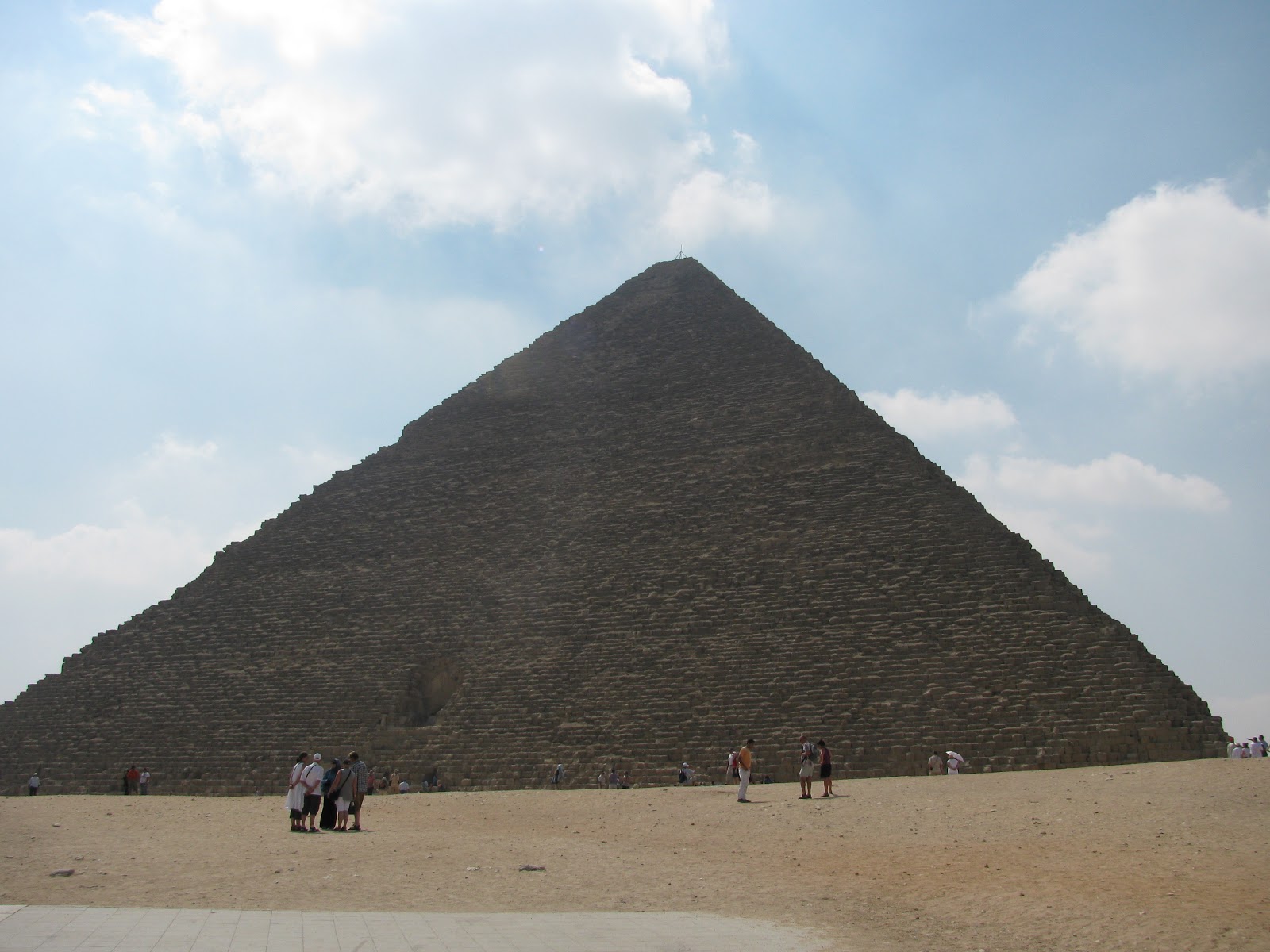
At first we stopped near the Great Pyramid of Giza, also called the Pyramid of Khufu and the Pyramid of Cheops. Built 4500 years before (Even before Jesus Christ), by the great Egyptian Pharaoh Khufu, the Pyramid still stand as the largest and oldest of the Egyptian Pyramids. 

The Great Pyramid of Giza
Standing in front of the tallest man made structure over the world, our guide told some interesting tales about it. It seems, Khufu’s adviser Hemon is the man who designed the idea of pyramids. The average estimate is that it must have taken almost twenty years to construct this Pyramid. Therefore the construction must have begun during the lifetime of Khufu itself.

The construction of Pyramids was done with the casing stones, which were quarried to the spot through the Nile. In the Stone Age, it’s unimaginable to take away such an action since each day they had to install approximately 800 tonnes of stones. I couldn’t quite understand when our guide mentioned that the construction of Pyramid happened from top to bottom than from bottom to the top.

Can you locate the two chamber doors?
There are two chambers inside the Pyramid dedicated to the King and his favorite Queen. The King’s chamber is at the center of the Pyramid and was amassed with treasures. The treasure is now put for show at the Museum and the chamber is empty now.  It seems, originally, King Khufu’s chamber was designed to be at a lower chamber. But the proud Pharaoh might have changed his mind and moved up his burial chamber higher up in the Pyramid.

The Queen’s chamber is adorned with some shafts which were explored by scientist for further treasure. However they didn’t dare to break in, since many of the shafts might be supporting the entire structure of Pyramids. However, a German engineer Rudolf Gantenbrink used a crawler robot by name Upaut 2 to crawl in the shafts in 1992. The robot stopped at a limestone door. Soon, National Geographic society created a small robot and let him go through a small drill in the discovered door. The second robot found a larger door behind the first one. 

When we had visited, our guide told that the doors must also be a trap to prevent robbers from robbing the treasures. The entire structure might come down with the destruction of any of the doors. However, the project continued by Djedi team in 2011 and using a micro snake camera, they found out some hieroglyphs in red paint, ornamental structures etc.

Can you spot us in front of the Entrance?
We went near the Pyramids to be photographed. Even one stone was higher than us and had the width more than three of us standing in a row. As we climbed up and stood before the entrance to King’s Chamber, we felt at the top of the world. The ascend was quite tiring since it took a long way than looking from beneath.

Owing to this unique construction many people believed that the Gods must have aided the construction of the Pyramids. Scientists have another explanation that they must have created by some natural eruption.  However, we were convinced of its creation under the magical hands of men who were determined, hard working, dedicated and above all part of a wonderful creation that would be proudly marveled by generations to come.

Tuesday, June 21, 2011

Citadel of Saladin-The Proud Minaret of the City


 Continues from A Night at Cairo!

Our travel guide/Egyptologist was scheduled to meet us by 8am at the hotel lobby. We woke up duly in accordance with the alarm at 6 am. After the delicious buffet breakfast at the Hotel restaurant, we were ready for our guide. The view of Nile was so majestic and we hardly realized that time got slipped to 9am in our watch. It was then that we got the call from our Egyptologist.

Sreejith teased him while keeping the phone “You were supposed to come by 8 am, right?”

“But it’s only 8 am now, Sir!”

It’s then that we realized that the time in Egypt is one hour behind the K.S.A time.

It is so pity that I don’t remember the tourist guide’s name at this time. He was the best among his lot followed and very friendly too. He suggested us to watch the Citadel of Saladin, which was not there in our itinerary but one of the eminent minaret1 in the city of minarets.  We readily complied. 

The citadel of Saladin is situated at Mokattam hills overlooking the famous limestone quarries of the Cairo. On our way to the Citadel, our guide explained the past glory of the citadel with its fresh breeze and best views of the city. However as Cairo grew, it started to grow to the outskirts too. The earlier place for public cemetery, on the way to the citadel is now dwelled with houses. The citadel is now a preserved historic site for visitors. Well, this is not only the story of Cairo but of all major cities.

In front of Alabastor Mosque
We reached the Citadel of Saladin within half an hour. Built in the years between 1176 and 1183 CE; the citadel stand as the proud token of its constructor’s glory. Though resembles Tipu Sultan’s palaces and Mysore Palace of India from outside, the citadel has a quite unique view inside. The most attractive area was definitely the 200 years old mosque with Alabastor roof. The mosque is also known as alabaster roof for this.

As we approached and looked up, the silver shining of the Alabastor roof changed to silver blue under the grey clouds. Built in 1528, the mosque is the first of its kind to be built in Ottoman style2 in the country. It seems Sultan Mohammad Ali had brought the architect Yousf Boushnaq, a Turkish man to construct the mosque in the style of a Turkish turban.

Just as in Indian temples, we had to remove our foot wares before entering the ablution area that leads to the mosque. Only thing is that we can carry foot wares in our hands. At the same door, I saw Muslim women covering the foreign ladies in green cloaks. I thought it to be custom and approached them. They asked me to proceed since I had covered my shoulders and knees.

In front of the Ablution Fountain
The courtyard with the ablution area looked so magnificent.  The courtyard with the ablution fountain was covered with pillars roofed with small domes. Our guide told that the structures are called the riwaqs. An elaborate French clock was there across the north western area of the courtyard. It seems, king Luis Philip of France presented it to Mohamed Ali in exchange for an Egyptian Obelisk. Our guide added with a grin that the clock never worked properly since its arrival.

We went near the ablution fountain to take some pictures. The magnificent octagonal shape was adorned by 8 pillars and covered by a large leaded domed canopy. The floral motifs on the small dome inside the main one looked so natural with authentic ornaments. Yet we still hadn’t marveled the real architecture. Our guide led us inside the mosque soon.

The Chandeliers beneath the Dome
The first that caught our attention was an array of chandeliers. They were hanging beneath the magnificent green coloured domes. Our guide informed us that there are totally 365 chandeliers, which were lit as oil lamps in the old days. The central dome and the surrounding half domes are designed in the shape of Turkish turban courtesy to its architect. A glittering and enchanting chandelier hung in the middle of the mosque. It was again a gift to Egypt by King Louis Philippe V of France.

The Holy Shrine
We sat on the red carpet marveling the artistic creation and cool ambience. The holy shrine at the end of the mosque was restricted to enter. In the old days, the priests/ Sheiks first entered the shrine through a path covered with pure gold. There was also a similar path near to the shrine made with limestone. The main shrine was made in old pure gold and indeed spectacular in view.

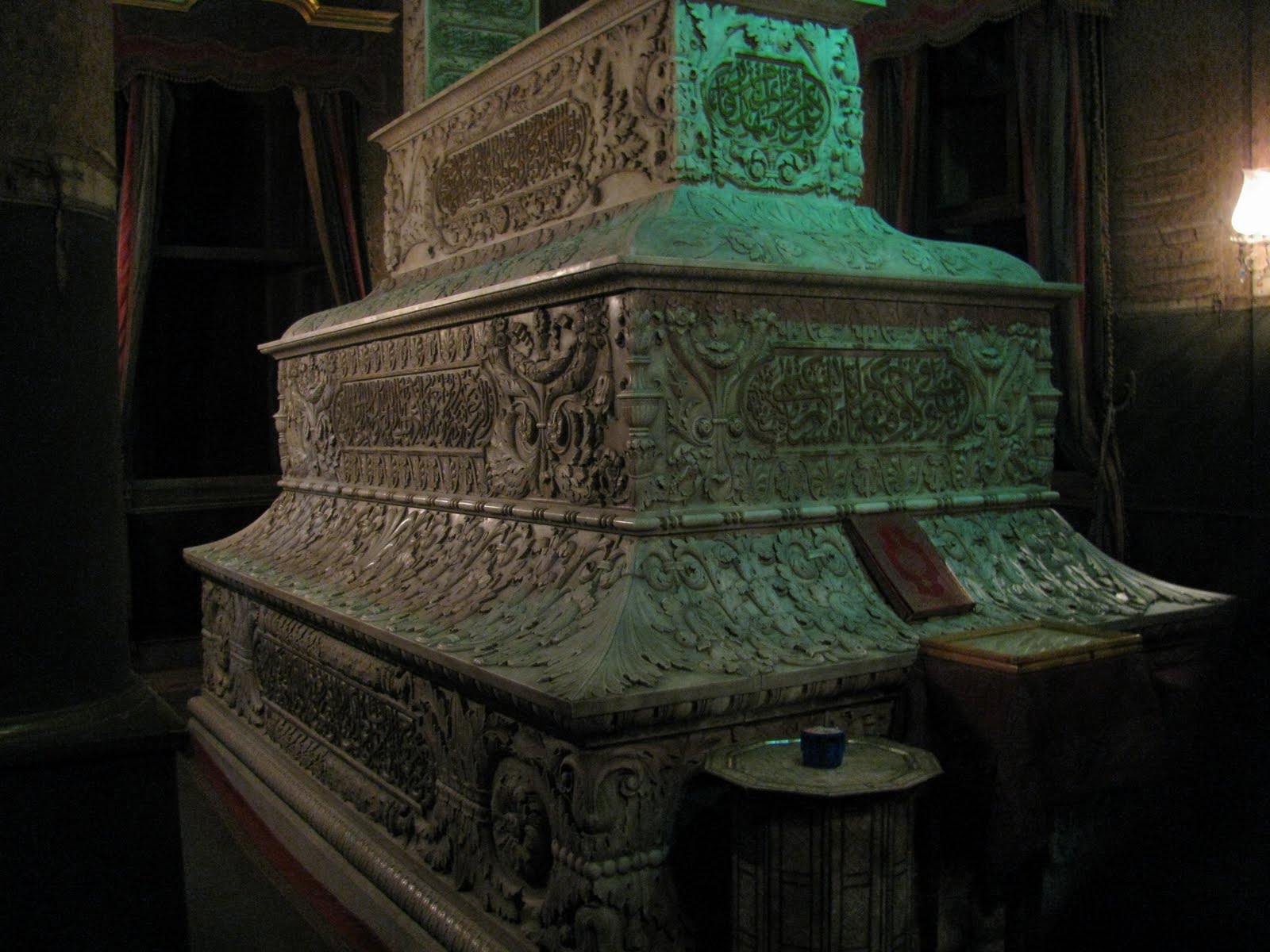
Mohamed Ali's Tomb
At the right side of the entrance is the tomb of Mohamed Ali.  Usually, there is no practice to have a tomb inside the mosque. However upon Mohamed Ali’s wish, his successor King Abbas I transferred the original tomb inside. Here, Mohamed Ali rests in peace inside the white Italian marble tomb, decorated with floral motifs, pointed and glided inscriptions. Even after his death, his soul must be proud of the umpteen visitors that marvel his creation.

We came out of the mosque after half an hour of entering it. There was a vast view of Cairo at the exit of the mosque. We didn’t have time to visit the carriage museum and the palace since we had to head straight to the Pyramids of Geiza.

Shreya Getting Dressed Up
On the way out from the citadel we stopped at the instant studio to take the picture of Shreya as Egyptian princess. She loved the deck up and happily went with the photographers for the shooting. As a policy, we were detained from taking her pictures by own camera. However, as the girls hoisted her in the backdrop of the mosque, many foreigners crowded around to take the shots. Lights flashed around her from numerous cameras.  Well, that was a happy scene. Who wouldn’t like to see their daughter as a princess and in limelight?

1. Minarets: More information  
2. Ottoman Style: More information


Sunday, June 19, 2011

A Night at Cairo!

Continues from Pyramids Tell a Glittering Tale... 


After the light and sound show at the Pyramids, we headed straight to the closest Duty free shop. I hadn’t allowed Sreejith to stock drinks from the Airport in the hope to find pubs and local hangout places. However it had turned out that all the pubs would be closed in Egypt during Ramzan period. 

Our expedition to the nearest duty free shop took one hour drive from Hotel Nile in the hectic Egyptian traffic. As we reached the duty free shop, I was surprised to see pictures of Aishwarya Rai outside the shop. It seems Egyptians consider her more than their native beauties on these days.  Definitely I felt proud to watch the admiration for the Indian beauty.

In the duty free shop, we showed our identity proofs as suggested by Ameer. It seems natives are never allowed to have drinks in the country. I suggested Sreejith to take Malibu, the world famous drink of Caribbean. I don’t know what prompted him to take my advice. We packed our purchase and headed back through the tiring traffic.

A View of Cairo Tower Across the Nile

After our dinner, we put Shreya to sleep and waited at the balcony to watch the city. The city was thriving with night life. We could breathe in the excitement in the enthralling night life on the streets. The Nile reflected the golden rays of lights from its shore. The Cairo tower glittered with blue rays across the waves. Though the Cairo tower has lost its prominence as the tallest tower in Egypt during 1960s, it still retained its charm.

Sreejith fixed the drink as the cool breeze from the Nile took us to contemplation. I sipped the drink along with Sreejith. “Phewww.........” we exclaimed together. The drink tasted so bad for us as a mixture of coconut water and pineapple juice. I had never tasted anything bad as that. Well, the world famous Malibu turned out exactly opposite to our taste.

Sreejith was quite distressed with this. He made it clear that I should finish the drink fixed for me. “Quite difficult,” I thought. Down, the city life was flowing in full vigor. We silently sat and admired the scene. At one point we wondered, “How much they are making out of their history, ancient stories and culture! Will India be ever able to so such systematic planning in tourism?”

Cairo at Night
The night was studded with blue and silver stars. Divine the delight to draw the night air from the Nile; from the luxurious cruises on its dark distance, from the quiet glittering sky overhanging all. Sreejith finished his drink and went to bed. After some time I slipped into the bathroom and poured the drink through wash basin. The next day, we would be going for Cairo tour. I wanted to wake up healthy and merry.

Continues in Citadel of Saladin-The Proud Minaret of the City