Showing posts with label citadel saladin. Show all posts

Thursday, June 23, 2011

Pyramids, Pyramids, Pyramids & Pyramids.........


 Continues from Citadel of Saladin

We headed straight to the Pyramids of Geiza soon after our visit at the Citadel of Saladin. On our way to the Pyramids, our guide told us the interesting history of the Pyramids. We were very much interested with the descriptions and asked him whether these three are the only Pyramids in Egypt. He smiled and answered: ‘Let’s see!”

We were hoping to stop at the garden through which we had gone for previous night’s light and sound show. Instead, we stopped at a desert with no shade even for an ant. We realized that this is what night and day can play to you in a desert. Our guide took the tickets to the Pyramids asked us to follow. 

At first we stopped near the Great Pyramid of Giza, also called the Pyramid of Khufu and the Pyramid of Cheops. Built 4500 years before (Even before Jesus Christ), by the great Egyptian Pharaoh Khufu, the Pyramid still stand as the largest and oldest of the Egyptian Pyramids. 
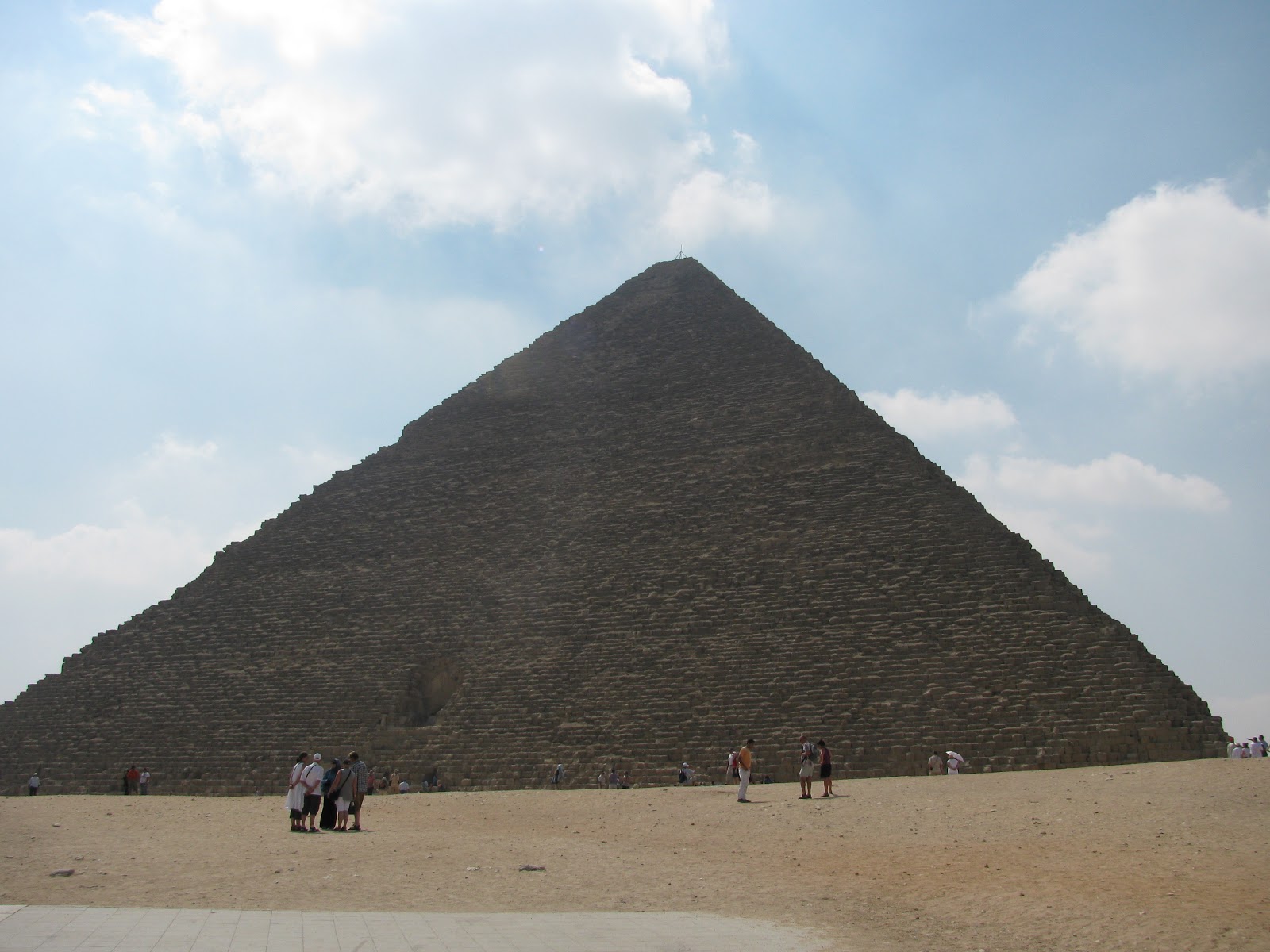
The Great Pyramid of Giza
Standing in front of the tallest man made structure over the world, our guide told some interesting tales about it. It seems, Khufu’s adviser Hemon is the man who designed the idea of pyramids. The average estimate is that it must have taken almost twenty years to construct this Pyramid. Therefore the construction must have begun during the lifetime of Khufu itself.

The construction of Pyramids was done with the casing stones, which were quarried to the spot through the Nile. In the Stone Age, it’s unimaginable to take away such an action since each day they had to install approximately 800 tonnes of stones. I couldn’t quite understand when our guide mentioned that the construction of Pyramid happened from top to bottom than from bottom to the top.

Can you locate the two chamber doors?
There are two chambers inside the Pyramid dedicated to the King and his favorite Queen. The King’s chamber is at the center of the Pyramid and was amassed with treasures. The treasure is now put for show at the Museum and the chamber is empty now.  It seems, originally, King Khufu’s chamber was designed to be at a lower chamber. But the proud Pharaoh might have changed his mind and moved up his burial chamber higher up in the Pyramid.

The Queen’s chamber is adorned with some shafts which were explored by scientist for further treasure. However they didn’t dare to break in, since many of the shafts might be supporting the entire structure of Pyramids. However, a German engineer Rudolf Gantenbrink used a crawler robot by name Upaut 2 to crawl in the shafts in 1992. The robot stopped at a limestone door. Soon, National Geographic society created a small robot and let him go through a small drill in the discovered door. The second robot found a larger door behind the first one. 

When we had visited, our guide told that the doors must also be a trap to prevent robbers from robbing the treasures. The entire structure might come down with the destruction of any of the doors. However, the project continued by Djedi team in 2011 and using a micro snake camera, they found out some hieroglyphs in red paint, ornamental structures etc.

Can you spot us in front of the Entrance?
We went near the Pyramids to be photographed. Even one stone was higher than us and had the width more than three of us standing in a row. As we climbed up and stood before the entrance to King’s Chamber, we felt at the top of the world. The ascend was quite tiring since it took a long way than looking from beneath.

Owing to this unique construction many people believed that the Gods must have aided the construction of the Pyramids. Scientists have another explanation that they must have created by some natural eruption.  However, we were convinced of its creation under the magical hands of men who were determined, hard working, dedicated and above all part of a wonderful creation that would be proudly marveled by generations to come.

Tuesday, June 21, 2011

Citadel of Saladin-The Proud Minaret of the City


 Continues from A Night at Cairo!

Our travel guide/Egyptologist was scheduled to meet us by 8am at the hotel lobby. We woke up duly in accordance with the alarm at 6 am. After the delicious buffet breakfast at the Hotel restaurant, we were ready for our guide. The view of Nile was so majestic and we hardly realized that time got slipped to 9am in our watch. It was then that we got the call from our Egyptologist.

Sreejith teased him while keeping the phone “You were supposed to come by 8 am, right?”

“But it’s only 8 am now, Sir!”

It’s then that we realized that the time in Egypt is one hour behind the K.S.A time.

It is so pity that I don’t remember the tourist guide’s name at this time. He was the best among his lot followed and very friendly too. He suggested us to watch the Citadel of Saladin, which was not there in our itinerary but one of the eminent minaret1 in the city of minarets.  We readily complied. 

The citadel of Saladin is situated at Mokattam hills overlooking the famous limestone quarries of the Cairo. On our way to the Citadel, our guide explained the past glory of the citadel with its fresh breeze and best views of the city. However as Cairo grew, it started to grow to the outskirts too. The earlier place for public cemetery, on the way to the citadel is now dwelled with houses. The citadel is now a preserved historic site for visitors. Well, this is not only the story of Cairo but of all major cities.

In front of Alabastor Mosque
We reached the Citadel of Saladin within half an hour. Built in the years between 1176 and 1183 CE; the citadel stand as the proud token of its constructor’s glory. Though resembles Tipu Sultan’s palaces and Mysore Palace of India from outside, the citadel has a quite unique view inside. The most attractive area was definitely the 200 years old mosque with Alabastor roof. The mosque is also known as alabaster roof for this.

As we approached and looked up, the silver shining of the Alabastor roof changed to silver blue under the grey clouds. Built in 1528, the mosque is the first of its kind to be built in Ottoman style2 in the country. It seems Sultan Mohammad Ali had brought the architect Yousf Boushnaq, a Turkish man to construct the mosque in the style of a Turkish turban.

Just as in Indian temples, we had to remove our foot wares before entering the ablution area that leads to the mosque. Only thing is that we can carry foot wares in our hands. At the same door, I saw Muslim women covering the foreign ladies in green cloaks. I thought it to be custom and approached them. They asked me to proceed since I had covered my shoulders and knees.

In front of the Ablution Fountain
The courtyard with the ablution area looked so magnificent.  The courtyard with the ablution fountain was covered with pillars roofed with small domes. Our guide told that the structures are called the riwaqs. An elaborate French clock was there across the north western area of the courtyard. It seems, king Luis Philip of France presented it to Mohamed Ali in exchange for an Egyptian Obelisk. Our guide added with a grin that the clock never worked properly since its arrival.

We went near the ablution fountain to take some pictures. The magnificent octagonal shape was adorned by 8 pillars and covered by a large leaded domed canopy. The floral motifs on the small dome inside the main one looked so natural with authentic ornaments. Yet we still hadn’t marveled the real architecture. Our guide led us inside the mosque soon.

The Chandeliers beneath the Dome
The first that caught our attention was an array of chandeliers. They were hanging beneath the magnificent green coloured domes. Our guide informed us that there are totally 365 chandeliers, which were lit as oil lamps in the old days. The central dome and the surrounding half domes are designed in the shape of Turkish turban courtesy to its architect. A glittering and enchanting chandelier hung in the middle of the mosque. It was again a gift to Egypt by King Louis Philippe V of France.

The Holy Shrine
We sat on the red carpet marveling the artistic creation and cool ambience. The holy shrine at the end of the mosque was restricted to enter. In the old days, the priests/ Sheiks first entered the shrine through a path covered with pure gold. There was also a similar path near to the shrine made with limestone. The main shrine was made in old pure gold and indeed spectacular in view.

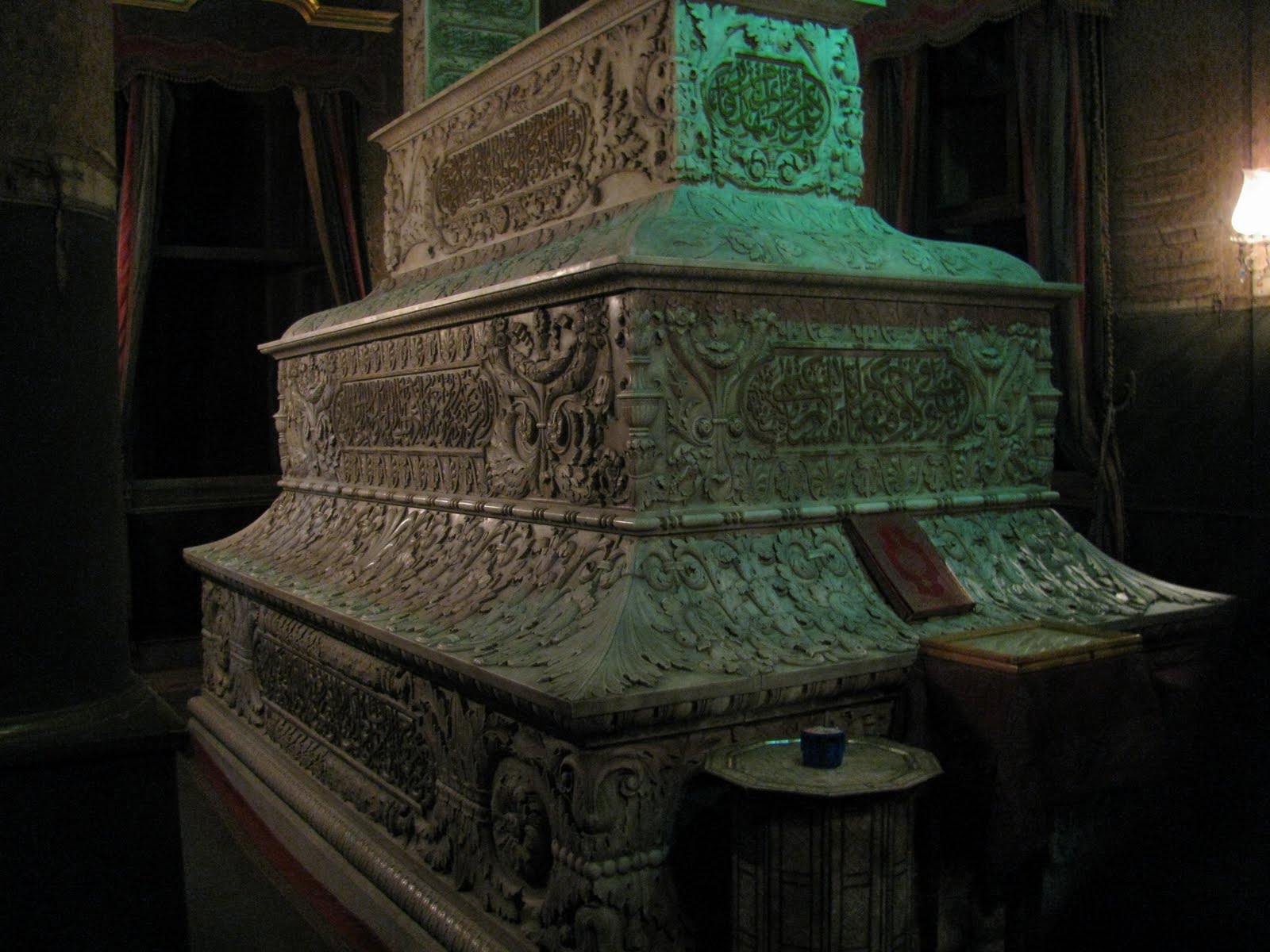
Mohamed Ali's Tomb
At the right side of the entrance is the tomb of Mohamed Ali.  Usually, there is no practice to have a tomb inside the mosque. However upon Mohamed Ali’s wish, his successor King Abbas I transferred the original tomb inside. Here, Mohamed Ali rests in peace inside the white Italian marble tomb, decorated with floral motifs, pointed and glided inscriptions. Even after his death, his soul must be proud of the umpteen visitors that marvel his creation.

We came out of the mosque after half an hour of entering it. There was a vast view of Cairo at the exit of the mosque. We didn’t have time to visit the carriage museum and the palace since we had to head straight to the Pyramids of Geiza.

Shreya Getting Dressed Up
On the way out from the citadel we stopped at the instant studio to take the picture of Shreya as Egyptian princess. She loved the deck up and happily went with the photographers for the shooting. As a policy, we were detained from taking her pictures by own camera. However, as the girls hoisted her in the backdrop of the mosque, many foreigners crowded around to take the shots. Lights flashed around her from numerous cameras.  Well, that was a happy scene. Who wouldn’t like to see their daughter as a princess and in limelight?

1. Minarets: More information  
2. Ottoman Style: More information